> ## Documentation Index
> Fetch the complete documentation index at: https://docs.pro.commure.com/llms.txt
> Use this file to discover all available pages before exploring further.
# Bulk User Edit
> The Bulk User Edit feature lets administrators configure settings for multiple users at one time.
## Editing User Settings in Bulk
The *Bulk User Edit* feature lets administrators configure settings for multiple users at one time. All properties configured using this method override the existing user values. These changes cannot be undone, so be sure to always use this feature with extreme care. **Bulk User Edit** is accessible to the users listed in the table below.
| Accessible To: | If: |
| ------------------------ | -------------------------------------------------------------------------------------------------------------------------------------------------------------------------------------------------------------------------------------------------------------------------------------------------------------------------------------------------------------------------------------------- |
| Level 0/1 administrators | If their **[Level 0/1: Can Use Bulk User Edit](../at_ug/user#level-0/1-can-use-bulk-user-edit)** parameter is set to Yes (under **User > User Permissions**) |
| Level 2 administrators | If their **[Level 2: Can Edit Users in Assigned Departments](../at_ug/user#level-2-can-edit-users-in-assigned-departments)** parameter is set to Yes (under **User > User Permissions**), and alsoIf their **[Level 2 (w/edit users): Can Use Bulk User Edit](../at_ug/user#level-2-department-administrator-user-permissions)** parameter is set to Yes (under **User > User Permissions**) |
## Bulk User Edit Interface
To access the Bulk User Edit feature, select the **Admin** tab and then the **Bulk User Edit** tab.
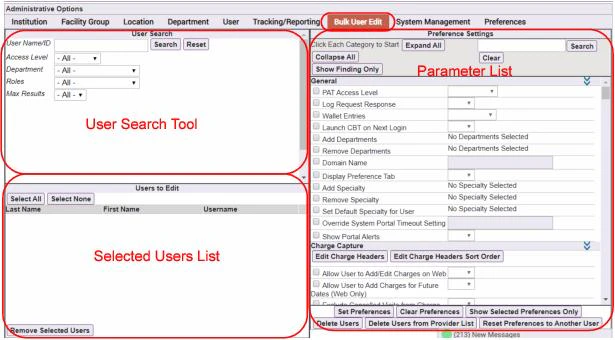 The **Bulk User Edit** screen consists of a user search tool in the upper left corner, a list of currently selected users in the lower left corner, and a list of available parameters and possible values that can be set in bulk on the right side of the screen.
## Selecting Users
To select users for bulk editing:
1. Enter any of the following search criteria, in any combination, in the User Search Tool area in the top left corner of the screen:
* **User Name/ID:** Enter one or more alphanumeric characters in the user's first name, last name, system username, or personnel ID.
* **Access Level:** Select PAT access level **1**, **2**, or **3**.
* **Department:** Select one of the available departments.
* **Roles**: Select any role other than **All** to narrow your search scope to users with a particular role, such as referring providers only.
* Max# of Search Results: Select the maximum number of results you would like to see displayed in one screen.
2. Click the **Search** button.
3. From the resulting list, select those users who you want to add to the **Users to Edit** list. Click once in a row to select a particular user, click again to de-select the user.
4. Click the **Add Selected Users** button. All users that you selected from the User Search results are added to the **Users to Edit** pane, to be edited in bulk.
5. To reset the search criteria, click the **Reset** button. Then repeat the preceding steps until you have selected all users who you want to edit.
## De-selecting Users
To remove users from the selected users list:
1. Select or de-select one or more users from the list in the lower left corner of the Bulk User Edit screen using one of the following methods:
* Select an individual user by clicking its row.
* Select all users by clicking the **Select All** button.
* De-select all users by clicking the **Select None** button.
2. Click **Remove Selected Users**. All selected users are removed from the list.
## Setting Parameters for Selected Users
When your list includes only the users to be edited:
1. Check the box at the beginning of the row of each parameter you want to assign. Checking a parameter box enables the choices available for that parameter.
2. Set the value using one of the following methods, depending on the parameter:
* By selecting one value from a drop-down list of multiple choice selections
* By entering text into a text box
* By checking boxes in a check box list, for example to select the modules that you want to be available for all selected users
3. To clear the selected parameters, click the **Clear Preferences** button. Repeat the preceding steps to select the desired parameter values.
Before performing the next step, make sure that you truly want to set these preferences for all selected users. It is not possible to undo a bulk user edit once you click **Set Preferences**. Use this feature with extreme caution.
4. To assign the selected parameters to the selected users, click **Set Preferences**.
5. A question box pops up with a message stating, "*This will set the `` selected preference(s) for the `` user(s) you have chosen. This can not be undone, are you sure that you want to continue?*" If you are, click **Yes**; otherwise, click **No**.
6. If you click **Yes**, the parameters are set as configured for the selected users. An information box then appears, informing you that the preferences have been successfully set. Click **OK** to dismiss the box.
7. Verify the new settings for the selected users on the **User** tab.
### Copying Preferences from Another User
When your Selected Users List includes only the users to be edited:
1. Click the **Reset Preferences to Another User** button.
A confirmation dialog box displays all currently selected users, and provides a search field to locate the user with the preferences to copy.
2. Click the **Search** button , scroll to locate and select the user that has the preference settings that you want to copy to the currently selected users.
3. Click **Save**.
The preference settings of all users from the Selected Users List are updated with the configuration preferences of the selected user.
### Displaying Parameters by Category
The **Expand All** and **Contract All** buttons let you alternate between two Parameter List views. Click **Contract All** to view the category headers that are used to organize each list of parameters. Click the Expand/Contract Category icon associated with a category header to expand one or more specific categories only.
Click **Expand All** to see each complete parameter list under its associated category heading.
## Editing Charge Headers for Selected Users
Once you have selected the list of users, you can edit Charge Headers for those users:
1. Click the Edit Charge Headers button. The Charge Transaction Headers window opens.
2. Use this dialog as described in **[Add/Edit Charge Headers](../at_ug/institution#add/edit-charge-headers)**.
Use this option with caution, as any changes you make via this option affect all of the currently selected users. If you make changes to a few headers and then realize they were in error, the only way to reverse them is to use this option again and reset them to their previous state.
However, you can reset *all headers* for the selected users back to the institutional default headers by clicking the **Reset All Headers** button at the bottom of the screen.
## Editing the Sort Order of Charge Headers
You can re-order the display of charge headers beyond the standard sort functionality that is available through the **Edit Charge Headers** button. A second button, **Edit Charge Headers Sort Order**, enables you to re-position charge headers with more granularity than is available through standard sort operations.
To re-order individual charge headers from the **Reorder Charge Transaction Headers** window, select each header that you want to move and use the four buttons (**Top**, **Up**, **Down**, **Bottom**) to move these headers into the correct sort order.
## Notes About Bulk Editing
The following sections provide helpful pointers when using the **Bulk User Edit** option.
### Changing Simple Preferences
In general, changing a value for a preference overwrites the former value for that field. For example, when you set Allow User to Create Charge Macros to Yes or No, the new selection simply overwrites the former selection.
### Changing Preferences Related to Sending Transactions to the Holding Bin
The user preferences related to sending transactions to the Holding Bin are interrelated and function differently from others in the **Bulk User Edit** option. These settings contains the following list of checkbox options:
* **Send All Transactions to Holding Bin**:
* Selecting Yes for this option in **Bulk User Edit** sets the **Send All Transactions to Holding Bin** option for all of the chosen users to Yes, which in turn also sets all of the related child options to Yes (**Send Transactions with Validity Errors or Non-Forced Code Edits to Holding Bin**, **Send Transactions with Free Text to Holding Bin**, **Send Transactions with Comments to Holding Bin**, and **Send Imported Transactions to Holding Bin**).
* Selecting No for this option in **Bulk User Edit** sets only the **Send All Transactions to Holding Bin** option for all of the chosen users to No,
* **Send Transactions with Validity Errors or Non-Forced Code Edits to Holding Bin**, **Send Transactions with Free Text to Holding Bin**, **Send Transactions with Comments to Holding Bin**, and **Send Imported Transactions to Holding Bin**: Selecting Yes or No for any of these options sets *only* those options to Yes or No for the chosen users. It does *not* affect any of the other options. For example, if you set **Send Transactions with Validity Errors or Non-Forced Code Edits to Holding Bin** to Yes, then the **Send Transactions with Validity Errors or Non-Forced Code Edits to Holding Bin** option is set to Yes for all chosen users. If one of the users also already had the **Send Transactions with Free Text to Holding Bin** option set to Yes, that option would remain set to Yes.
If you have a group of users for whom you want *only* specific child options to be selected, you should follow a two-step process. For example, maybe you want *only* the **Send Transactions with Validity Errors or Non-Forced Code Edits to Holding Bin** option to be set to Yes for a group of users. First, set the **Send All Transactions to Holding Bin** option to No to clear any previously selected options for those users. Next, set to Yes only the specific child option(s) that you want for those users (**Send Transactions with Validity Errors or Non-Forced Code Edits to Holding Bin**, in our example).
### Autonomous Coding Settings
The Charge Capture category includes settings for managing Autonomous Coding (AC) across multiple users at once:
* **Hold Autonomously Coded Charge for Review** — controls whether charges generated by Autonomous Coding are automatically placed in the holding bin for manual review before submission. Options: Yes, No, or Prompt.
* **AC Schedule Start Date** — sets the date when Autonomous Coding becomes active for the selected users.
* **AC Schedule END Date** — sets the date when Autonomous Coding is deactivated for the selected users.
These settings correspond to the per-user AC controls found under **[User > Charge Capture Settings](../at_ug/user#charge-capture-settings)**. Bulk editing is useful when onboarding or offboarding a group of providers for Autonomous Coding.
### Adding or Removing Roles or Modules
You can add one or more modules by enabling the **Add Modules** setting, which belongs to the Device section of the Bulk User Edit Preference Settings. When you click this setting, the list of available modules displays. Note that the Patient List module is always included on all handheld platforms, so it is not included among the other modules.
You can remove a module by enabling the **Remove Module** setting and then selecting the module to remove from the drop-down list.
In environments using multiple mobilizers, changes to this setting do not take effect until you clear the cache on each of the mobilizer servers.
In the Provider Info section, there are similar options to **Add Roles** or **Remove Roles**. These function in a similar manner to the **Add Modules** and **Remove Modules** options described above.
### Adding Wallet Entries
Level 0 and level 1 administrators can use this option to add basic wallet entries for a defined group of users. Note that you must configure the individual usernames and passwords manually via the following setting:
Admin - User - General - **[Wallet Entries](../at_ug/user#wallet-entries)**
Or, in some cases, these may be automatically created the first time a user attempts to access the external system. The section entitled *[Adding an External System Definition](../at_ug/customizations#adding-an-external-system-definition)* provides more information about automatic creation of wallet entries.
## Exporting and Importing User Data
Authorized administrators can export user data to a file from the **Bulk User Edit** screen. Use the search filters in the **User Search** pane to obtain a complete or partial list of all users that are currently configured in the system. When the list of users you want displays under the User Search results on the **Bulk User Edit** screen, click the **Export (Excel)** button. You are prompted to open or save a zip file, which includes an Excel document containing the following data for each of the selected users:
* User name: The user's login name
* Departments: The list of departments to which the user belongs
* Roles: The list of roles that the user has in the system (for example, "Provider" or "Referring")
* User level: The user's administrative level
* User numbers: The user's provider ID number (and associated facility)
* Created date: The creation date for this user's account in the system.
* Modified date: The most recent date that data pertaining to this user was changed in the system.
Typically, administrators will want to import their user data file at a later time. Note that the import process is designed to read this data exactly as it was written to the file, so do not make changes to the format of this file between the export and import processes. To import user data, administrators can click the **Browse** button associated with the **Load Users (Excel)** setting, navigate to where the user data file is stored, and then click the **Import** button. Note that during import, the application obtains the user name from the Excel document, whereas the data referenced within this file is fetched from the saved records. This process is used to ensure that the import operation reflects any changes that were made in this data between the export and import operations.
The **Bulk User Edit** screen consists of a user search tool in the upper left corner, a list of currently selected users in the lower left corner, and a list of available parameters and possible values that can be set in bulk on the right side of the screen.
## Selecting Users
To select users for bulk editing:
1. Enter any of the following search criteria, in any combination, in the User Search Tool area in the top left corner of the screen:
* **User Name/ID:** Enter one or more alphanumeric characters in the user's first name, last name, system username, or personnel ID.
* **Access Level:** Select PAT access level **1**, **2**, or **3**.
* **Department:** Select one of the available departments.
* **Roles**: Select any role other than **All** to narrow your search scope to users with a particular role, such as referring providers only.
* Max# of Search Results: Select the maximum number of results you would like to see displayed in one screen.
2. Click the **Search** button.
3. From the resulting list, select those users who you want to add to the **Users to Edit** list. Click once in a row to select a particular user, click again to de-select the user.
4. Click the **Add Selected Users** button. All users that you selected from the User Search results are added to the **Users to Edit** pane, to be edited in bulk.
5. To reset the search criteria, click the **Reset** button. Then repeat the preceding steps until you have selected all users who you want to edit.
## De-selecting Users
To remove users from the selected users list:
1. Select or de-select one or more users from the list in the lower left corner of the Bulk User Edit screen using one of the following methods:
* Select an individual user by clicking its row.
* Select all users by clicking the **Select All** button.
* De-select all users by clicking the **Select None** button.
2. Click **Remove Selected Users**. All selected users are removed from the list.
## Setting Parameters for Selected Users
When your list includes only the users to be edited:
1. Check the box at the beginning of the row of each parameter you want to assign. Checking a parameter box enables the choices available for that parameter.
2. Set the value using one of the following methods, depending on the parameter:
* By selecting one value from a drop-down list of multiple choice selections
* By entering text into a text box
* By checking boxes in a check box list, for example to select the modules that you want to be available for all selected users
3. To clear the selected parameters, click the **Clear Preferences** button. Repeat the preceding steps to select the desired parameter values.
Before performing the next step, make sure that you truly want to set these preferences for all selected users. It is not possible to undo a bulk user edit once you click **Set Preferences**. Use this feature with extreme caution.
4. To assign the selected parameters to the selected users, click **Set Preferences**.
5. A question box pops up with a message stating, "*This will set the `` selected preference(s) for the `` user(s) you have chosen. This can not be undone, are you sure that you want to continue?*" If you are, click **Yes**; otherwise, click **No**.
6. If you click **Yes**, the parameters are set as configured for the selected users. An information box then appears, informing you that the preferences have been successfully set. Click **OK** to dismiss the box.
7. Verify the new settings for the selected users on the **User** tab.
### Copying Preferences from Another User
When your Selected Users List includes only the users to be edited:
1. Click the **Reset Preferences to Another User** button.
A confirmation dialog box displays all currently selected users, and provides a search field to locate the user with the preferences to copy.
2. Click the **Search** button , scroll to locate and select the user that has the preference settings that you want to copy to the currently selected users.
3. Click **Save**.
The preference settings of all users from the Selected Users List are updated with the configuration preferences of the selected user.
### Displaying Parameters by Category
The **Expand All** and **Contract All** buttons let you alternate between two Parameter List views. Click **Contract All** to view the category headers that are used to organize each list of parameters. Click the Expand/Contract Category icon associated with a category header to expand one or more specific categories only.
Click **Expand All** to see each complete parameter list under its associated category heading.
## Editing Charge Headers for Selected Users
Once you have selected the list of users, you can edit Charge Headers for those users:
1. Click the Edit Charge Headers button. The Charge Transaction Headers window opens.
2. Use this dialog as described in **[Add/Edit Charge Headers](../at_ug/institution#add/edit-charge-headers)**.
Use this option with caution, as any changes you make via this option affect all of the currently selected users. If you make changes to a few headers and then realize they were in error, the only way to reverse them is to use this option again and reset them to their previous state.
However, you can reset *all headers* for the selected users back to the institutional default headers by clicking the **Reset All Headers** button at the bottom of the screen.
## Editing the Sort Order of Charge Headers
You can re-order the display of charge headers beyond the standard sort functionality that is available through the **Edit Charge Headers** button. A second button, **Edit Charge Headers Sort Order**, enables you to re-position charge headers with more granularity than is available through standard sort operations.
To re-order individual charge headers from the **Reorder Charge Transaction Headers** window, select each header that you want to move and use the four buttons (**Top**, **Up**, **Down**, **Bottom**) to move these headers into the correct sort order.
## Notes About Bulk Editing
The following sections provide helpful pointers when using the **Bulk User Edit** option.
### Changing Simple Preferences
In general, changing a value for a preference overwrites the former value for that field. For example, when you set Allow User to Create Charge Macros to Yes or No, the new selection simply overwrites the former selection.
### Changing Preferences Related to Sending Transactions to the Holding Bin
The user preferences related to sending transactions to the Holding Bin are interrelated and function differently from others in the **Bulk User Edit** option. These settings contains the following list of checkbox options:
* **Send All Transactions to Holding Bin**:
* Selecting Yes for this option in **Bulk User Edit** sets the **Send All Transactions to Holding Bin** option for all of the chosen users to Yes, which in turn also sets all of the related child options to Yes (**Send Transactions with Validity Errors or Non-Forced Code Edits to Holding Bin**, **Send Transactions with Free Text to Holding Bin**, **Send Transactions with Comments to Holding Bin**, and **Send Imported Transactions to Holding Bin**).
* Selecting No for this option in **Bulk User Edit** sets only the **Send All Transactions to Holding Bin** option for all of the chosen users to No,
* **Send Transactions with Validity Errors or Non-Forced Code Edits to Holding Bin**, **Send Transactions with Free Text to Holding Bin**, **Send Transactions with Comments to Holding Bin**, and **Send Imported Transactions to Holding Bin**: Selecting Yes or No for any of these options sets *only* those options to Yes or No for the chosen users. It does *not* affect any of the other options. For example, if you set **Send Transactions with Validity Errors or Non-Forced Code Edits to Holding Bin** to Yes, then the **Send Transactions with Validity Errors or Non-Forced Code Edits to Holding Bin** option is set to Yes for all chosen users. If one of the users also already had the **Send Transactions with Free Text to Holding Bin** option set to Yes, that option would remain set to Yes.
If you have a group of users for whom you want *only* specific child options to be selected, you should follow a two-step process. For example, maybe you want *only* the **Send Transactions with Validity Errors or Non-Forced Code Edits to Holding Bin** option to be set to Yes for a group of users. First, set the **Send All Transactions to Holding Bin** option to No to clear any previously selected options for those users. Next, set to Yes only the specific child option(s) that you want for those users (**Send Transactions with Validity Errors or Non-Forced Code Edits to Holding Bin**, in our example).
### Autonomous Coding Settings
The Charge Capture category includes settings for managing Autonomous Coding (AC) across multiple users at once:
* **Hold Autonomously Coded Charge for Review** — controls whether charges generated by Autonomous Coding are automatically placed in the holding bin for manual review before submission. Options: Yes, No, or Prompt.
* **AC Schedule Start Date** — sets the date when Autonomous Coding becomes active for the selected users.
* **AC Schedule END Date** — sets the date when Autonomous Coding is deactivated for the selected users.
These settings correspond to the per-user AC controls found under **[User > Charge Capture Settings](../at_ug/user#charge-capture-settings)**. Bulk editing is useful when onboarding or offboarding a group of providers for Autonomous Coding.
### Adding or Removing Roles or Modules
You can add one or more modules by enabling the **Add Modules** setting, which belongs to the Device section of the Bulk User Edit Preference Settings. When you click this setting, the list of available modules displays. Note that the Patient List module is always included on all handheld platforms, so it is not included among the other modules.
You can remove a module by enabling the **Remove Module** setting and then selecting the module to remove from the drop-down list.
In environments using multiple mobilizers, changes to this setting do not take effect until you clear the cache on each of the mobilizer servers.
In the Provider Info section, there are similar options to **Add Roles** or **Remove Roles**. These function in a similar manner to the **Add Modules** and **Remove Modules** options described above.
### Adding Wallet Entries
Level 0 and level 1 administrators can use this option to add basic wallet entries for a defined group of users. Note that you must configure the individual usernames and passwords manually via the following setting:
Admin - User - General - **[Wallet Entries](../at_ug/user#wallet-entries)**
Or, in some cases, these may be automatically created the first time a user attempts to access the external system. The section entitled *[Adding an External System Definition](../at_ug/customizations#adding-an-external-system-definition)* provides more information about automatic creation of wallet entries.
## Exporting and Importing User Data
Authorized administrators can export user data to a file from the **Bulk User Edit** screen. Use the search filters in the **User Search** pane to obtain a complete or partial list of all users that are currently configured in the system. When the list of users you want displays under the User Search results on the **Bulk User Edit** screen, click the **Export (Excel)** button. You are prompted to open or save a zip file, which includes an Excel document containing the following data for each of the selected users:
* User name: The user's login name
* Departments: The list of departments to which the user belongs
* Roles: The list of roles that the user has in the system (for example, "Provider" or "Referring")
* User level: The user's administrative level
* User numbers: The user's provider ID number (and associated facility)
* Created date: The creation date for this user's account in the system.
* Modified date: The most recent date that data pertaining to this user was changed in the system.
Typically, administrators will want to import their user data file at a later time. Note that the import process is designed to read this data exactly as it was written to the file, so do not make changes to the format of this file between the export and import processes. To import user data, administrators can click the **Browse** button associated with the **Load Users (Excel)** setting, navigate to where the user data file is stored, and then click the **Import** button. Note that during import, the application obtains the user name from the Excel document, whereas the data referenced within this file is fetched from the saved records. This process is used to ensure that the import operation reflects any changes that were made in this data between the export and import operations.